
When the Internet Goes Quiet: A Month of Disconnection and Discovery
When the Wi‑Fi drops for a day, it’s an inconvenience. When it disappears for a month, it becomes a teacher.
Living without internet for thirty days in Newfoundland feels like being pulled back into the rhythm of the land and sea — tides instead of timelines, weather instead of notifications. At first, it’s disorienting. Then, it’s clarifying.
As I mentioned, hubby and I moved into an apartment building at the end of April. We just had the luck that after the apartment renovation of the unit, we were left with no way of accessing the internet and had to wait for installers to be scheduled to come. As I had minimal data on my phone plan, I was stuck.
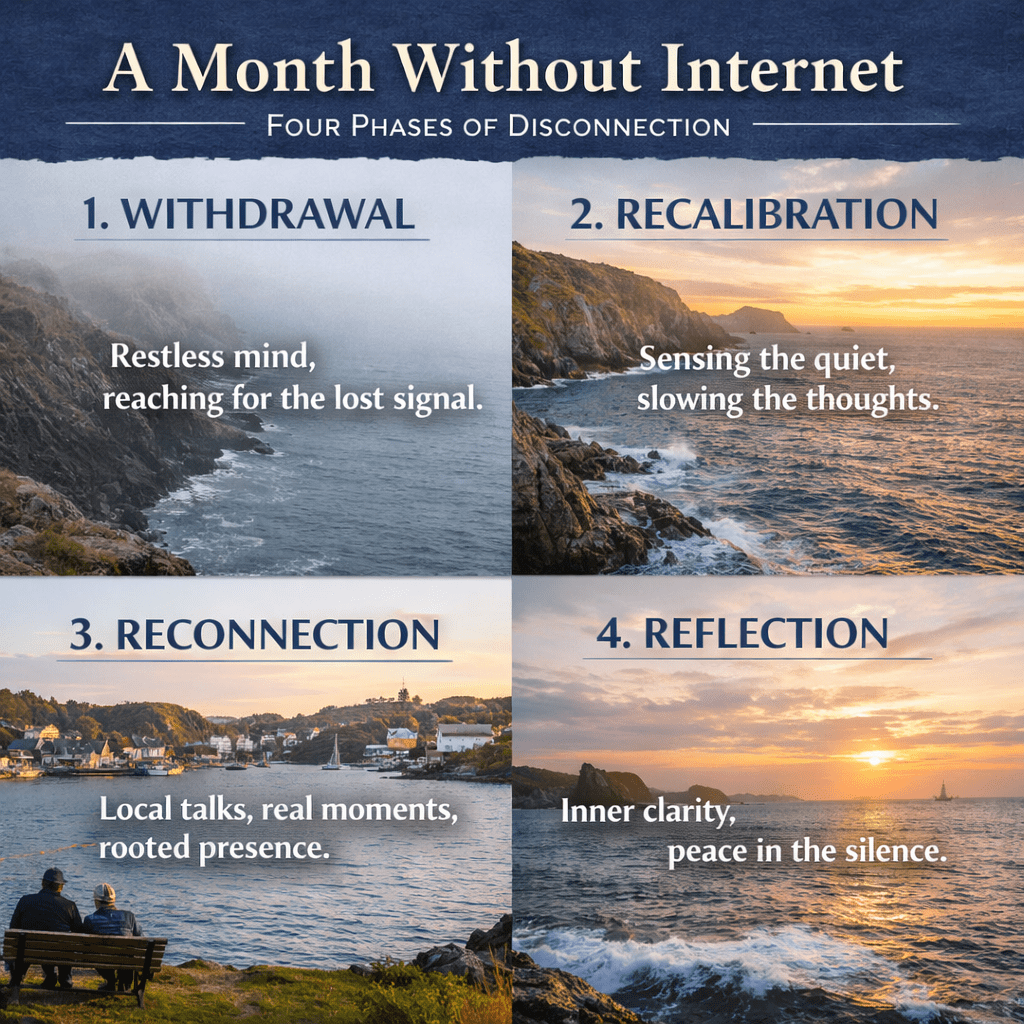
Phase One: Withdrawal and Restlessness
The first week feels like you’re standing in fog. You reach for your phone out of habit, only to find silence. No updates. No messages. No validation loops.
It’s uncomfortable — not because you’re missing information, but because you’re missing stimulation. Your brain, conditioned by constant input, starts to crave the next ping.
This is where metacognition awareness is beneficial: noticing the craving, naming it, and watching it pass.
Phase Two: Recalibration
By week two, the nervous system starts to settle. Your thoughts slow down even more, enough to hear themselves.
Without the internet’s constant noise, your mind starts sorting what’s real, what’s imagined, and what’s simply habitual. You realize how much of your attention was outsourced to algorithms. Now, you’re the one choosing what to think about.
I found myself spending more time in self-care: taking long, hot, bubble baths, spending more time organizing and getting our new space set up. I even took the time to organize my new desk the way I wanted.
Phase Three: Reconnection — But Locally
By week three, connection takes on a different meaning. I found myself outside more, meeting my new neighbours and getting to know the open space around the property. I found many benches and picnic tables set up outside, where you can sit and take your time soaking up the sunshine. I would walk to the stores, which are closer now. I shared stories face‑to‑face. I even talked more with my hubby! The social world shrinks, but it deepens.
I start to trust that not every thought needs to be broadcast. Some ideas are meant to ripen quietly, like berries on the bush. I learned that presence — not performance — is what builds real community.
Phase Four: Reflection and Integration
By week four, the silence feels like home. You’ve stopped measuring your worth by engagement metrics. You’ve started measuring it by peace.
When the internet finally returns, you don’t rush to fill the quiet. You log back in differently — with boundaries, with awareness, with choice.
You realize that disconnection wasn’t a loss; it was a recalibration. It taught you to trust your own internal compass again.
The Lesson
A month without internet is a metacognitive reset. It reveals how much of your thinking was reactive, and how much can become intentional. It reminds you that your mind, like the Newfoundland coastline, has its own tides — ebbing and flowing between solitude and connection.
You don’t forget the digital storm. You simply stop living as if it’s still overhead. Awareness becomes your compass. And your mind becomes a coastline you know how to read.
Discover more from Stella Reddy's Story of Hope
Subscribe to get the latest posts sent to your email.

