
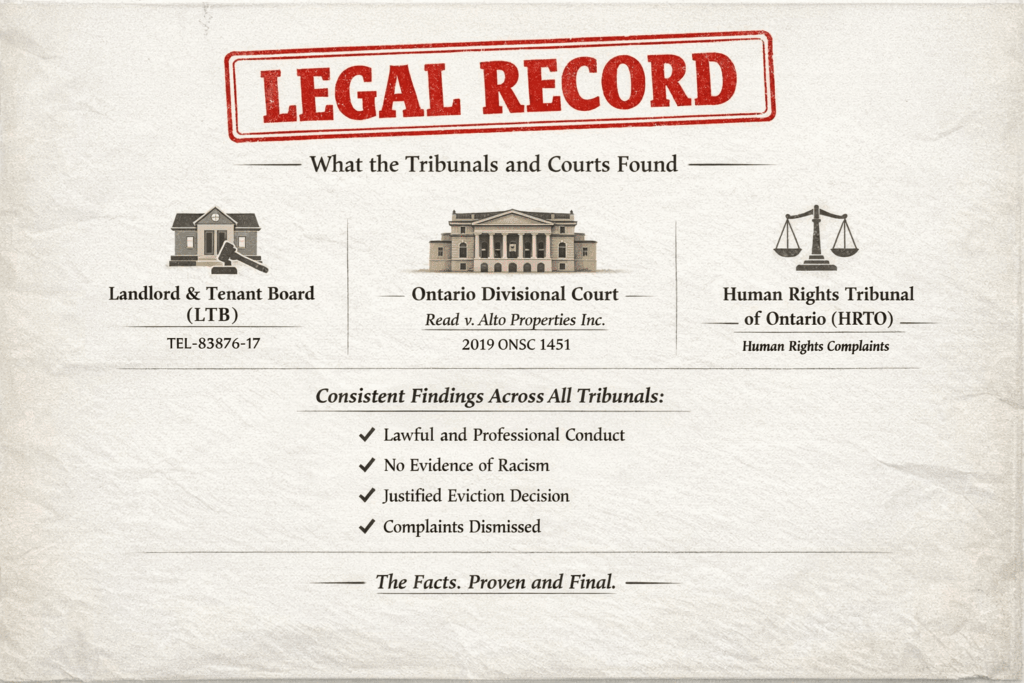
Legal Record: What the Tribunals and Courts Found
This post provides a clear, factual summary of the legal decisions related to my former role as a building superintendent in this matter, from 2017 to 2020, arising from claims brought by former tenants. As I have mentioned before, I prefer to rely on factual information in professional situations. With AI, I can finally get a less emotional view of these legal decisions.
These decisions come from three independent bodies – the Landlord and Tenant Board (LTB), the Ontario Divisional Court, and the Human Rights Tribunal of Ontario (HRTO). Each reviewed the same events from different angles, using different laws and standards. You can see all these decisions on Calii.org through the links below.
Legal Actions
- Landlord and Tenant Board Eviction Document released October 3, 2017: TEL-83876-17 (Re), 2017 CanLII 84930 (ON LTB) https://canlii.ca/t/hpbxw
- Divisional Court Document Released April 15, 2019: https://canlii.ca/t/hzs47
- Human Rights Tribunal of Ontario was released on January 22, 2020, after KR & AR didn’t show up for the Hearing by Teleconference: ER v. Liscio, 2020 HRTO 73 (CanLII), <https://canlii.ca/t/j4z4w>, ER v. Liscio, 2019 HRTO 415 (CanLII), <https://canlii.ca/t/hz14r>
Across all of them, the findings were consistent.
The purpose of sharing this record is simple: to present the truth as it was determined by the legal system, in full transparency and without emotion. It is about time I was able to do that, with help!
Landlord and Tenant Board (TEL‑83876‑17)
The LTB heard the landlord’s application in September 2017. After reviewing the evidence from both sides, the Board found:
- The tenants repeatedly refused lawful access to the rental unit, even in writing.
- The notices of entry were properly served and reasonable.
- The superintendent’s actions were professional and lawful.
- The allegations of racism were not supported by evidence.
- The refusal of access substantially interfered with the landlord’s rights.
- The eviction was justified, with extra time granted for the family to relocate.
The Board also noted that while the relationship had become hostile, the hostility did not originate from staff actions. The conflict stemmed from the tenants’ ongoing refusal to cooperate with lawful procedures.
Ontario Divisional Court Appeal (Read v. Alto Properties Inc., 2019 ONSC 1451)
The tenants appealed the LTB decision to the Divisional Court. A panel of three judges reviewed the full record, including transcripts, evidence, and the LTB’s reasoning.
The Court upheld the LTB decision in full.
Key findings included:
- There was no bias by the LTB Member.
- The decision was reasonable, fair, and supported by evidence.
- The superintendent’s conduct was not motivated by racism.
- Even if a comment was racially insensitive, it did not influence any professional actions.
- The tenants’ refusal of access was the central issue, and it justified termination of the tenancy.
This decision confirmed that the LTB handled the matter properly and that the findings were sound.
Human Rights Tribunal of Ontario (HRTO)
The tenants later filed four Human Rights applications alleging discrimination and reprisal, with 2 of them against me, each asking for $1million. The HRTO reviewed the materials and raised several concerns:
- Many allegations were untimely.
- The issues had already been appropriately dealt with by the LTB and the Divisional Court.
- The applications did not appear to have a reasonable prospect of success.
- There was no clear evidence linking the tenants’ allegations to any Code‑protected ground.
A hearing was scheduled for January 17, 2020. The applicants did not attend.
On January 22, 2020, the HRTO dismissed all four applications as abandoned.
This closed the matter completely.
What These Decisions Show
Taken together, these decisions form a clear and consistent record:
- No tribunal or court found any wrongdoing by the landlord or me.
- All allegations of racism and harassment were rejected or found unsupported.
- The tenants’ own conduct—refusing access, escalating conflict, and ignoring procedures—was the cause of the tenancy breakdown.
- Every legal body upheld the professionalism of the building staff.
- The final human rights applications were dismissed when the applicants chose not to appear.
This record is not about blame. It is about clarity.
It shows that the accusations made against me were examined thoroughly and independently, and they did not stand up to scrutiny.
Why I Share This
I share this legal record because truth matters. My name matters. And the work I did—honestly, professionally, and within the law—deserves to be understood in its proper context.
These decisions speak for themselves. They reflect the facts, not opinions. They show the difference between a professional situation and the personal narrative that was projected onto it.
Legal records are important; they help provide the clarity that is needed.
Discover more from Stella Reddy's Story of Hope
Subscribe to get the latest posts sent to your email.

