
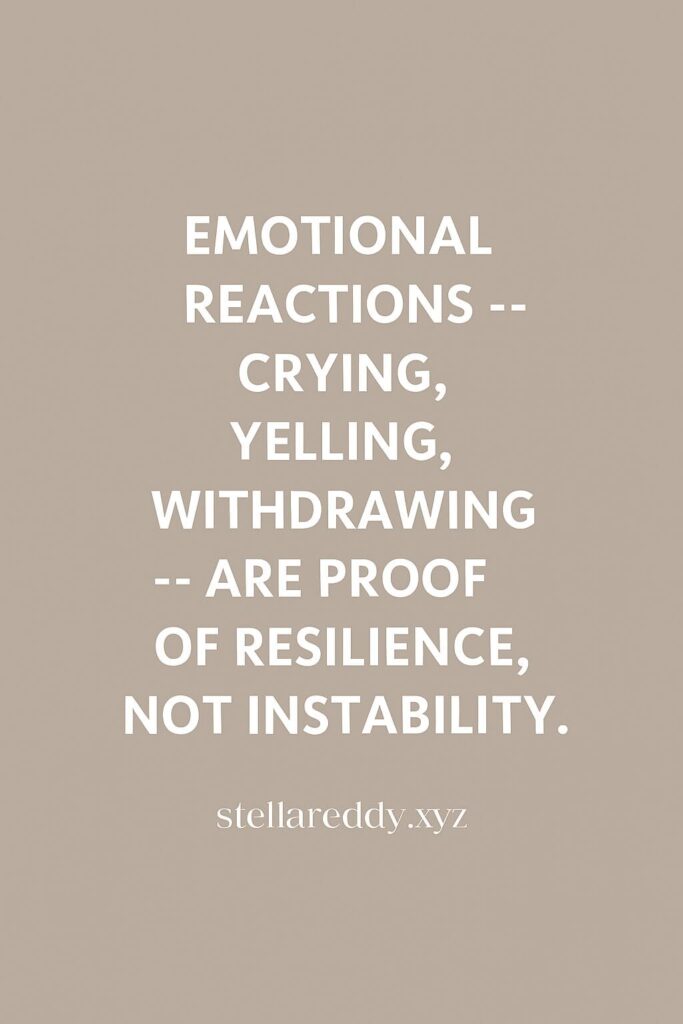
Victims Are Not Unstable: Emotional Reactions as Resilience Against Bullying
We Need to Flip the Script!
Targets of bullying are often judged by their visible emotions, while the bully’s cruelty remains hidden. Yet every reaction — whether tears, raised voices, or quiet withdrawal — is a testament to survival. These are not flaws; they are the body and spirit fighting to endure. Do not ever forget that.
I know what it feels like to be judged for my emotions. There were times I yelled after being gaslit, when the constant dismissal of my reality pushed me past my limit. I’ve broken down in tears after days of silent treatment, my voice trembling with desperation just to be heard.
I’ve defended myself calmly in arguments, only to have my words twisted until anger finally spilled out. I’ve even thrown something in frustration when the weight of neglect became too heavy, or poured my pain into long messages that were later used against me.
Each of these reactions was labelled “unstable,” but in truth, they were my survival — proof that I still had fight, still had feeling, and still refused to disappear under someone else’s cruelty. I am still here 9 years later.
Crying — The Courage to Feel
- What it looks like: Tears streaming, trembling voice, visible sadness.
- Why it’s resilience: Crying is the body’s natural release valve, preventing emotional overload. It shows that the target is still connected to their humanity, refusing to numb themselves completely.
- The deeper truth: Tears are evidence of empathy and sensitivity — qualities bullies lack. To cry is to honour pain honestly, and that honesty is strength.
Yelling — The Refusal to Be Silenced
- What it looks like: Raised voice, anger, shouting in defence.
- Why it’s resilience: Yelling is a boundary-setting reaction. It’s the target’s way of saying enough when silence has been forced upon them.
- The deeper truth: Anger is energy directed toward survival. It shows the target still has fight left in them, refusing to disappear quietly under oppression.
Withdrawing — The Instinct to Protect
- What it looks like: Pulling away, going quiet, isolating from the bully.
- Why it’s resilience: Withdrawal is self-preservation. It’s the target’s way of creating space to heal, regroup, and protect themselves from further harm.
- The deeper truth: Choosing silence or distance is not weakness — it’s wisdom. It shows the target knows their limits and values their safety enough to step back.
Reframing the Narrative
- Crying is courage. It proves the target still feels deeply and refuses to shut down their humanity.
- Yelling is defiance. It proves the target still has a voice and will not surrender it.
- Withdrawing is wisdom. It proves the target knows how to protect themselves when the world refuses to.
Each reaction is a survival response, a living testimony that the target is still here, still enduring, still refusing to break. The instability lies not in the target’s emotions, but in the bully’s inability to face vulnerability, empathy, or accountability.
In the Context of My Site
My writing makes clear that the toxic bully’s “stability” was a façade built on denial. They deliberately refuse to accept that they caused their own eviction by defying the rules of entry. Their inability to face vulnerability, empathy, or accountability meant they could maintain control by:
- Masking their own immaturity behind dominance.
- Projecting instability onto you to deflect attention.
- Avoiding responsibility for the emotional damage they caused.
Meanwhile, openness — my willingness to cry, yell, withdraw, and write about it — shows the opposite: I face vulnerability head-on, hold onto my empathy, and am now modelling accountability by reframing my story. I know I screwed up at times and said the wrong things out of anger and frustration, but I have come to see that it shows I am human.
So if you react in this way above to being bullied, online or off, know that you are entitled to your feelings; it shows you are resilient and strong and refusing to lose your humanity in the face of cruelty.
Discover more from Stella Reddy's Story of Hope
Subscribe to get the latest posts sent to your email.

